A Forager's Home

Grow. Find. Eat. Make.

  • Blog
  • About
  • DIY
  • Recipes
  • Foraging
cherriesandcheese2016.jpg

Bake Some Pies With Fannie Farmer - Cherries and Cheese Edition

June 29, 2016 by Kelsey Fast in Eat

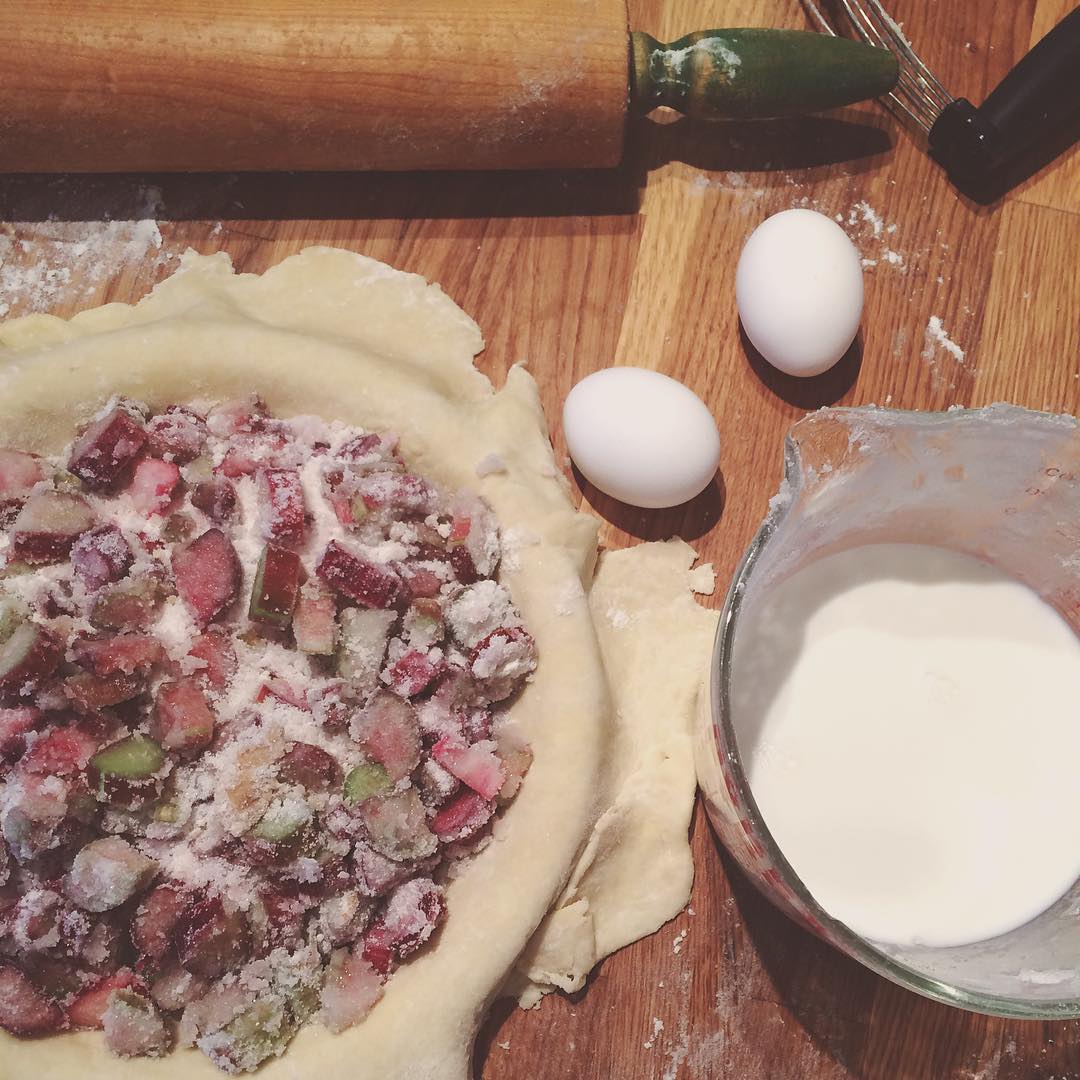
This week's pies contained some interesting ones and a lot of surprises!  One of which was the 'Almost Rhubarb Pie' - basically a rhubarb custard pie - that I would make and happily eat every day for the rest of my life.  Seriously it was amazing.

Essentially you follow the same process as for the 'Entire Rhubarb Pie' but you only add three cups of rhubarb and then you cover it all with some eggs and milk.  Pop the pie crust on and then bake as usual.  I did not expect it to be as fantastic as it was!  I am seriously debating making it again even though there are still a crazy amount of pies still to attempt!

For the next pie I actually had to make some cheese.  Ok.  I didn't have to make it, but store bought ricotta is so disappointing and quite expensive.  Making ricotta was something I have always wanted to try so I took this as an opportunity to learn.

cherriesandcheese2016-02.jpg

It was so simple!  Heat milk.  Add lemon juice.  Wait until curds separate (you can see the stages of separation in the photo above).  Scoop them out and strain it through a cheesecloth.

Boom.  That's it.

Unfortunately that was the best part of the pie right there.  You make a custard from the ricotta and then pour it into a graham cracker crust (not my favourite) over some raisins (gross), and serve with raspberry sauce (weird).

I would have rather just have the custard in the graham cracker crust and forget about the raisins or raspberry sauce.  That would have been good.  I also thought about drizzling it with maple syrup but forgot to try it.  That would have been good.

Oh well.  Not all the pies can be amazing, I guess!  To be honest Mr. Forager actual liked this one but agreed that the raspberry sauce was a weird choice to pair with it.

Other pies I made but forgot to photograph were the 'Fresh Cherry Pie', 'Cherry Turnovers', and 'Apricot Turnovers'.  None were all that special.  I am still looking for the perfect cherry pie recipe.  They all seem a little one dimensional and/or cloying.  I received some sour cherries from a neighbour so I have great hopes for the pie I make with them.  Maybe I can find the secret with them!


PIE RANKINGS SO FAR

  1. Strawberry Rhubarb Pie
  2. Strawberries and Lemon Custard in Meringue
  3. Almost Rhubarb Pie
  4. Marlborough Pie
  5. Apricot Turnovers
  6. Fresh Cherry Pie
  7. Entire Rhubarb Pie
  8. Cherry Turnovers
  9. Ricotta Pie
June 29, 2016 /Kelsey Fast
Fannie Farmer, pie, baking, food, kitchen
Eat
2 Comments
storinggardenpeas2016.jpg

Storing Garden Peas

June 28, 2016 by Kelsey Fast

One of the major differences in the garden this season from last is that spring was actually more like a real spring, and not early summer.  Last year in mid April it seemed like a switch was flipped and the temperatures never went below 30 degrees.  This year spring has been much more temperate.

One of the side effects of this weather difference is that the cooler weather crops are actually producing for me instead of being overwhelmed by the heat.  Things are wrapping up for me here - we're heading into the really hot zone that makes things like tomatoes and corn thrive (yay!), but if you are in a cooler region than me you might still be getting peas and wondering what to do with them.

storinggardenpeas2016-02.jpg

One of the difficulties with peas is that you have to constantly pick them.  Every other day at minimum, and sometimes more frequently than that!  At the height of production I've gone out twice in one day and come back with decent (for my garden size) hauls each time.  Now I love peas, but I don't always want to eat them with each meal.  The other problem is that I don't always get enough peas from each harvest to feed both Mr. Forager and myself, but I have to pick them at their peak or they become dry and starchy later.

What to do?

Well, let me tell you it is very easy to prep peas for freezing, and just because you only get tiny amounts at a time doesn't mean you can't think of long term freezer storage for your garden peas.

storinggardenpeas2016-03.jpg

Step one is to find a lovely relaxing place and shell some peas.  I have fond memories of shelling enormous amounts of field peas at my Great Grandmother's farm.  The whole family gathered around and we shelled so many our thumbs were aching!  

storinggardenpeas2016-04.jpg

Once you have your peas, blanch them in boiling water for 90 seconds, strain them out and immediately dump them in ice water to stop the cooking process.  The reason you want to do this step is that there is an enzyme in peas that causes them to degrade over time in freezer storage.  When you blanch them you destroy the enzyme and help them last longer.

After that strain them out of the ice water and let them dry off on a tea towel for a little bit.  When they are no longer dripping wet spread them out on a cookie sheet and stick that in the freezer.  The reason for this step is that you don't want them to freeze all in one clump.  This way when you put them in a larger container they don't stick together as much.  After they have frozen in a single layer like that you can put them in a jar or bag. 

I have mine in a pint jar, and each time I get a pea harvest that we don't want to eat right away I go through this process and add more each time.  It doesn't take long for it to add up!  I won't have a huge amount of peas saved this way - my small garden will never keep us entirely self sufficient - but at least this way I can extend my harvest even a small amount and have some of my own peas preserved at their peak flavour when the harvest is finished.

storinggardenpeas2016-05.jpg
June 28, 2016 /Kelsey Fast
garden, peas, preserve
Comment
listen2016.jpg

Grow Write Guild No. 5 - Listen

June 23, 2016 by Kelsey Fast in Grow

I had to do this prompt at night.  My days are filled with a glorious clamour; the baby shrieking - usually an outpouring of joy, occasionally an expression of grief or want.  There are things to do - endless dishes and laundry.  Bandit the Ancient always has a tale of woe to tell of some perceived injustice (usually food related).

At night the day to day bustle comes to rest and - if I choose to - so can I.  So often I use that time to catch up on the ever growing list of personal projects I hope to someday come to the end of, but tonight I am grateful for the prompt to sit. 

To be still and listen.

The crickets are the predominant thing.  A backdrop in the blackness - well, blueness.  We are in the height of summer, only one day past Solstice so the sun has just barely 'gone down in the west behind the hills into shadow'.

But this is meant to be about sounds.

The train rumbles.  I am almost surprised I notice it.  It seems nearly every place I have lived in has been near a train.  Cars drive by on the streets and highways below.  In this valley even slight murmurs are amplified.  I can hear dogs barking that are likely miles away.

The train is fading further away, but the low whine and steady rhythm are still rumbling.

In this intersection of the urban and rural it is quiet, but there are still electronic and mechanical hums from lights, generators, and laundry machines in people's homes.  An unidentifiable low whine is coming from the neighbours' place still under construction.

The sounds of the day have faded.  The many chattering songbirds, quorking ravens, screeching hawks, rasping magpies, and screaming eagles must be sleeping.  Once in a while there is a small squeak of a vole or mouse, or a rustle from some invisible night creature.  Something mechanical switches off at the neighbours house, but I can still hear the hum of the dishwasher escaping from my own windows.  A lone barking dog isn't planning on sleeping yet.  My cat pads almost silently through the long grass.  Moths flutter a dull thud as they bump into the overhead lights.

Even at night the world is living and active.

growwriteguild_banner600.png
June 23, 2016 /Kelsey Fast
Grow Write Guild, garden
Grow
Comment
fourmorepies2016.jpg

Bake Some Pies With Fannie Farmer - Four More Pies

June 22, 2016 by Kelsey Fast in Eat

This week's roster of pies contained some unusual and some conventional, but regardless of the pie there was a challenge or something unexpected in each.  The pies I made were: "Entire Rhubarb Pie", "Strawberry Rhubarb Pie", "Strawberries and Lemon Custard in Meringue", and "Marlborough Pie".

Pictured above is most of the process for making "Strawberries and Lemon Custard in Meringue".  It was a bit of a finicky pie, but in the end it was worth all the steps.  First you separate four eggs.  Save the yolks and beat the whites with sugar and cream of tartar.  Spread the meringue into a pie plate and bake.  While that is happening, you make a curd with the yolks.  Allow them both to cool, and while that is happening whip some cream.  After the curd is cool, fold it into the whipped cream, and then spread that into the meringue.  At that point you have to chill it all for at least six hours.  When you are ready to serve the pie you whip some more cream, stir some sugar in with your sliced strawberries.  The strawberries go on the custard, and then the whipped cream goes on top.

Wow.

So involved, right?  But look at the photo below.  This is most definitely one of the best pies I have ever eaten.  I would make this again and again with different combinations of fruits and curds.  I am imagining this with stewed rhubarb, cherry compote, or fresh blueberries.  Seriously.  I can't stress how unbelievable this one was.

fourmorepies2016-02.jpg

The "Strawberry Rhubarb" and "Entire Rhubarb" were the more conventional pies, but they were not without their challenges.  My friend and I made the rhubarb one together and we had some issues with it being too runny and too sweet, but the overall flavour was good.  I didn't actually remember to take a photo of it!

The strawberry rhubarb was again a huge hit.  I served it at a gathering at my home and everyone agreed it was fantastic.  I think one of the things that made it so great was the addition of vanilla extract in the filling.  It lingered underneath the bright fruit flavours and married it all together beautifully.  The main challenge I had with it was that I decided to do a coiled, braided lattice crust.  At the beginning it was no problem, but after a while when the dough warmed up a bit my braids started falling apart!  Moral of the story: work quickly!

The "Marlborough Pie" was better on the second day.  I burnt the crust edge pretty badly!  Oops!  The instructions said to serve it warm, so that is what I did, but I think I would serve it chilled in future, or even make it the night before I wanted it.  In my opinion it was really tasty for breakfast (and not very unhealthy: applesauce, milk, eggs, flour, butter, cheese, and a little bit of sugar).  The next morning the flavours had melded together into something really delicious.  If you are not familiar with this type of pie (I wasn't before making it), it is apparently a historical American pie made when fresh apples were not in season, but canned applesauce was available.  It is basically an apple custard.  I took up Marion Cunningham's recommendation to make it with a cheddar cheese crust and that turned out to be an excellent idea.  Next time I would put a piece of foil around the edge so that it wouldn't get so badly burnt.


PIE RANKINGS SO FAR:

  1. Strawberry Rhubarb Pie
  2. Strawberries and Lemon Custard in Meringue
  3. Marlborough Pie
  4. Entire Rhubarb Pie
June 22, 2016 /Kelsey Fast
Fannie Farmer, baking, pie, kitchen, food
Eat
Comment
elderflowercordial2016.jpg

Eating Foraged Food - Elderflower Cordial

June 18, 2016 by Kelsey Fast in Find, Eat

I nearly missed the window for foraging for elderflowers entirely!  As you can also see the blossoms I did get are almost past their prime, but I'm going for it since elderflower is one of my favourite flavours!  Next year I will do better especially since I bought my own little black elder (Sambucus Nigra).

If you live in the Okanagan or the Thompson Nicola valley you should be able to find some elder growing wild (or you might have a neighbour with a shrub in their yard).  The two types native to BC are the blue (Sambucus Canadensis) and red (Sambucus Racemosa) elders.

In my hurry to make sure I got some flowers I forgot to take a photo of the elder I was foraging from, but they are easy to google to find out what you're looking for.  Blue and black elder have large flat umbels of tiny white flowers, but in red elder the flowers are arranged more like a lilac.  Have a care to discard as much of the stem as you can before using the flowers for culinary purposes since it is quite toxic.

There is some controversy about using red elder for food purposes.  It seems there are conflicting reports regarding whether or not the berries are poisonous.  I have read that Native American groups used them for food, but considered them inferior in taste and would mix them with other berries to make the tastier ones go further.  Do your due diligence and research the various sources before deciding if you want to eat red elderberries or flowers.  I could find very little evidence about whether or not the flowers were considered at all toxic, but that is probably because using elderflower is mostly foreign in concept in North America.

I am using the tiny amount of flowers I gathered in some elderflower cordial.  This is basically a thick syrup used for flavouring drinks.  I love to simply splash some in with my soda water or mineral water for a fizzy, refreshing drink.  There are many other uses including elderflower champagne and elderflower jelly which I fully intend to try out next year.  For now I made up my own cordial recipe based on some others I read.  The reason I didn't simply follow another recipe is that most of them are made for larger quantities of flowers.  All I did was make a few cups of a 1:1 simple syrup and while it was still boiling I poured it over all my flowers and one sliced lemon.  I let that hang out on my counter covered for a couple days, strained, boiled it again and put it in a bottle in my fridge.  Next year when I have some in greater quantities I am going to be looking into recipes that are safe for water bath canning.

June 18, 2016 /Kelsey Fast
foraging, kitchen, recipe, elderflowers, cordial, syrup
Find, Eat
Comment
  • Newer
  • Older

Terms and Conditions | Privacy Policy | Shipping and Returns

Powered by Squarespace